

Telehealth
Eye Movement Desensitisation Reprocessing (EMDR)
Evidence-Based & Available Australia-Wide
Written by Natasha Kiemel-Incorvaia, Registered Psychologist | Last updated: April 2026
What is EMDR?
“EMDR therapy is an integrative, client-centered approach that treats problems of daily living based on disturbing life experiences that continue to have a negative impact on a person throughout the lifespan. Its Adaptive Information Processing theory hypothesizes that current difficulties are caused by disturbing memories that are inadequately processed, and that symptoms are reduced or eliminated altogether when these memories are processed to resolution using dual attention bilateral stimulation. The resolution of these targeted memories is hypothesized to result in memory reconsolidation. The standard application of EMDR therapy is comprised of eight phases and a three-pronged approach to identify and process: (a) Memories of past adverse life experiences that underlie present problems; (b)Present-day situations that elicit disturbance and maladaptive responses; and (c) Anticipatory future scenarios that require adaptive responses. There is strong empirical evidence for its use in the treatment of posttraumatic stress disorder, and it has also been found to be an effective, transdiagnostic treatment approach for a wide range of diagnoses in a variety of contexts and treatment settings with diverse populations.” - Laliotis et al., (2021).
Working with our registered telehealth psychologist, Natasha, to help manage your symptoms using the 8 phases of EMDR supports you in gaining a clearer understanding of your experiences and receiving tailored support. Natasha has over 5 years experience practicing EMDR and can also help you manage the symptoms you are experiencing through a range of accompanying therapeutic modalities to create a comprehensive treatment process.
Yes. Registered psychologists in Australia, including our psychologist Natasha, offer telehealth EMDR therapy via secure video consultations. Our psychologist, Natasha is registered with the Psychology Board of Australia and is an EMDRAA Full Member trained in EMDR therapy, with additional training in EMDR for complex PTSD and neurodiversity-informed approaches for EMDR. To verify your therapist's credentials, check the Psychology Board of Australia register or EMDRAA membership directory.
Can I find registered psychologists who offer EMDR therapy online in Australia?
What Symptoms Can Be Treated With EMDR?
Eye movement desensitisation reprocessing (EMDR) is a multiphase therapy. EMDR widely known as trauma treatment however EMDR is versatile and can be utilised to support you with a wide range of symptoms and conditions. You psychologist will help you determine if EMDR and/or online EMDR is the right fit for you and your symptoms. Below is a non-exhaustive list of symptoms which EMDR can be used to support you with.
Sleep disorder
Depression
Grief and loss
Post traumatic stress disorder
Further, our psychologist Natasha has completed advanced training in EMDR for complex PTSD, which allows her to work with clients who have experienced multiple or prolonged traumas. Additionally, she is trained in neurodiversity-affirming EMDR, meaning sessions can be tailored specifically for Autistic and ADHD clients, drawing on current research and best-practice.
Is online EMDR therapy as effective as in-person EMDR?
Research demonstrates that telehealth EMDR produces equivalent outcomes to in-person EMDR for post-traumatic stress disorder and other trauma-related conditions. A 2025 study comparing EMDR delivered online and in person found that people improved to a similar degree in both formats, suggesting that telehealth EMDR can be as effective as face‑to‑face EMDR when delivered by a trained psychologist.
Who is online EMDR suitable for?
Online EMDR may be particularly beneficial if you:
Live in a remote or regional area of Australia
Have mobility challenges or transportation difficulties
Prefer the comfort and familiarity of your home environment
Have work or caring responsibilities that make clinic visits difficult
Experience anxiety about attending appointments in unfamiliar settings
What makes online EMDR effective?
The effectiveness of online EMDR relies on the same core elements as in-person treatment:
Trained EMDR psychologist – Check for EMDRAA membership or Psychology Board of Australia registration
Secure bilateral stimulation tools – BilateralStimulation.io provides reliable, evidence-based visual stimulation
Safe therapeutic space – Your home environment can be just as effective as a clinic when properly prepared
Client readiness and engagement – Your psychologist will assess your suitability before commencing treatment
What are the 8 Phases of EMDR?
As EMDR is a multiphase therapy, your psychologist will work through each phase with you. Each phase comes with its own benefits. Each client will work through each phase at a different pace due to numerous personal factors.
It is therefore important to keep in mind that even though you may not be actively reprocessing a memory using bilateral stimulation, you are still engaging in EMDR. The phases before processing and foundational and directly influence how a memory is processed.
I know many clients are understandably eager to progress and get to phase 4, however I encourage you to have patience with yourself and know you are doing such important work in those initial 3 phases.
Phase 1. History & Treatment Planning
In this phase we discuss your mental health history and develop a collaborative treatment plan which primarily focuses on the traumatic events you want to process.

Phase 2. Preparation
In this phase we will work together to ensure you feel safe within the therapeutic space and set realistic expectations. You will be taught specific techniques designed to help you cope with any strong emotions that may arise during processing.
The length of this phase can vary significantly as each person's regulatory tolerance differs and it is important we minimize the risk of any maladaptive reactions before proceeding.
Phase 3. Assessment
During this phase we will identify the specific event you want to reprocess. For most, this will involve identifying images, beliefs, feelings, and sensations. However, sometimes we may modify how much detail we go into.
Next, before processing is commenced, a baseline is established through a short series of questions.
Phase 4. Desensitization
This is the phase most people think about when they hear EMDR. It involves having clients think of the traumatic event while engaging in eye movements, taps or other types of bi-lateral stimulation. It aims to help reduce your subjective units of distress and allow for the emergence of new thoughts, images and sensations. In online EMDR bilateral stimulation is conducted utilising a program in which you follow a ball on a screen. At times it may also include auditory bilateral stimulation and other variations.
Phase 5. Installation
Here we focus on strengthening the positive belief you would like to associate with the event we are targeting until it feels true to you.
Phase 6. Body Scan
In this phase you will be walked through a full body scan of your body while thinking about the target and positive belief.
Phase 7. Closure
Here we take the time to return to a state of calm and bring you back to the present moment, regardless of whether processing is complete or not.
Phase 8. Reevaluation
This phase is completed at the beginning of each session after processing.. We will discuss the event you processed in the last appointments to determine that your distress is still low and your positive belief still feels strong. We will then discuss future targets and evaluate the next steps in your treatment plan.
What To Expect In A EMDR Appointment
There are several steps/phases to EMDR treatment
Think of a troubling memory, then identify an image of the worst moment of that memory
Identify a negative belief about what worst moment
Identify emotions and bodily feelings linked to that moment
In the preparation phases you may be asked to:
Think about the image & belief whilst making left-to-right eye movements
Allow your mind to 'go with' whatever comes up and just notice what happens
This process will be repeated until the memory causes less distress (this may take one or multiple sessions
In the processing phases you may be asked to:
**Adapted from Psychology Tools EMDR Handout
Telehealth EMDR - What to Expect
What is Telehealth EMDR?
As you have learnt Eye Movement Desensitisation and Reprocessing (EMDR) is a structured therapy that helps individuals process and recover from traumatic experiences and distressing life events. Telehealth EMDR allows you to receive this effective treatment from the comfort of your own home through video consultations.
How is EMDR Administered Online?
During a telehealth EMDR session, our registered psychologist will guide you through the process using the video platform Zoom. One of the key components of EMDR is bilateral stimulation, which can be administered online through various methods, including:
Visual Stimulation: Using tools like BilateralStimulation.io, you will follow a moving ball on your screen with your eyes. Using this method you have the option to have your psychologist’s face on the screen or minimised completely. Your psychologist will be able to see you the whole time regardless of what option you choose.
Auditory Stimulation: Alternating tones or beeps will be played through your headphones.
Tactile Stimulation: You may use handheld devices that vibrate alternately in each hand, or you can tap your hands on your lap in a rhythmic pattern.
At times these methods may also be combined in an EMDR variation called EMDR 2.0 which Natasha is also trained in.
Which online platforms are best for EMDR therapy?
There are numerous online platforms and tools used for delivering EMDR therapy in Australia. Rather than one "best" platform, the most effective option depends on your individual needs and your psychologist's setup. Natasha, our psychologist, uses BilateralStimulation.io to provide visual bilateral stimulation during telehealth EMDR sessions.
About BilateralStimulation.io
BilateralStimulation.io is a free tool designed specifically for online EMDR therapy. It provides visual bilateral stimulation through animated patterns that move across your screen, allowing you to follow the movement with your eyes during your session. The tool is therapist-controlled, meaning Natasha will guide the speed and intensity of the stimulation based on your needs. It works seamlessly with Zoom and other telehealth platforms, requiring no download or setup from you – you simply click a link to access it during your session. BilateralStimulation.io is used by thousands of EMDR therapists worldwide, making it a reliable, evidence-based method for delivering bilateral stimulation online.
What You’ll See During Your Online EMDR Session
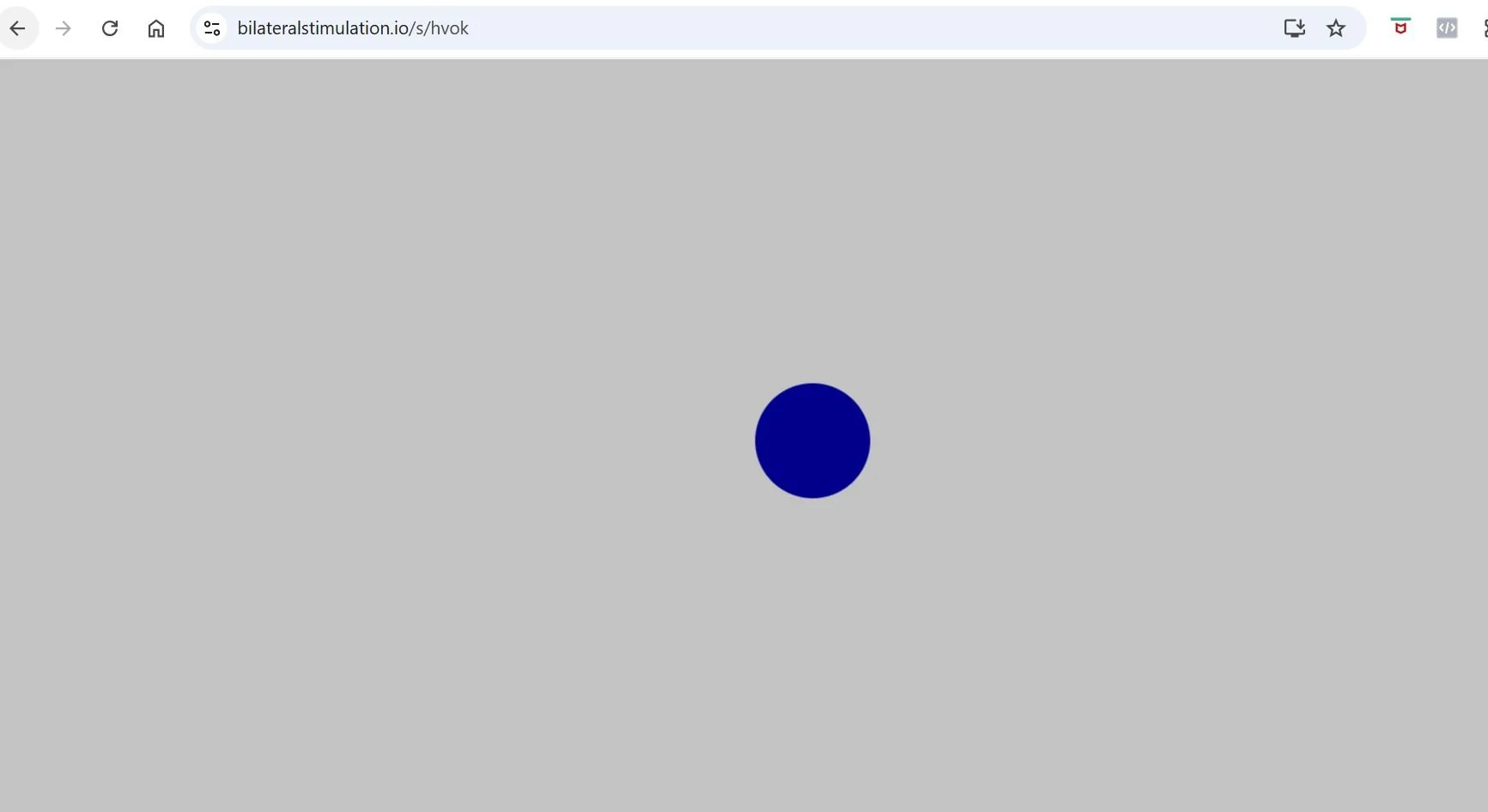
You can choose the colour of the ball
You can adjust the speed of movement
Natasha controls the settings during your session
No special equipment needed, works on any device. We recommend laptop, desktop or tablet.
What to Expect from an Online EMDR Bilateral Stimulation Session
Online EMDR therapy follows the same phases as in-person treatment, ensuring a consistent therapeutic experience. During the bilateral stimulation phase (Phase 4) of your telehealth EMDR session, your psychologist will guide you through the following steps:
You'll receive a link to bilateralstimulation.io (no personal information required, it will however note your IP).
Your psychologist will help you customise your visual and auditory preferences.
Together, you'll determine the optimal screen distance for your comfort.
You'll set your preferred speed for the visual ball stimulus.
This personalised approach ensures that the bilateral stimulation is tailored to your needs, maximizing the effectiveness of your online EMDR therapy.
Telehealth EMDR sessions are designed to provide accessible therapy options for clients across Australia. This mode of treatment may be suitable for individuals who face challenges with physical mobility, transportation, or those who prefer the familiarity of their home environment. Our aim is to offer a professional and supportive therapeutic experience that adheres to the highest standards of care and confidentiality.
Variations of EMDR - Tailoring Treatment to Individual Needs
While the standard EMDR protocol is effective for many, some clients may benefit from modified approaches. These variations are particularly important for individuals who may find the standard protocol overwhelming or ineffective due to the complexity of their trauma or their specific psychological needs. Each of these variations can be administered online via telehealth sessions.
Clients who may benefit from modified EMDR approaches include:
- Those with complex PTSD or multiple traumas
- Autistic and ADHD individuals, including AuDHD
- Individuals with dissociative disorders
- Clients who become easily overwhelmed or emotionally flooded
- Those with severe anxiety or panic disorders
- Individuals with depression or treatment-resistant depression
- Individuals with cognitive impairments or intellectual disabilities
- Clients with a history of treatment-resistant PTSD
For these individuals, the intensity of standard EMDR may be too challenging, potentially leading to re-traumatisation or treatment dropout. Modified approaches aim to provide a gentler, more gradual exposure to traumatic memories, allowing for better emotional regulation and a stronger sense of safety during the therapeutic process. If you want to learn more about EMDR variations check out my blog - EMDR Therapy Variations: Evidence-Based Approaches for Trauma Healing.
When Should You Start EMDR?
When each person should start EMDR therapy can vary considerably. It is important that you feel comfortable with your psychologist and trust that they can hold a safe space for you. It is also important you learn how to sit with distressing emotions and feel confident in your ability to cope with distressing memories with the support of your psychologist. There are also criteria your psychologist will assess to determine your readiness.
Each person may also spend a different amount of time in each phase of EMDR. As previously discussed due to the multiphase design of EMDR you can be engaging in EMDR without actively reprocessing a memory using bi-lateral stimulation.
If you feel you are ready to explore EMDR you can book an appointment to start the process and determine if it is a good fit for you. If by some chance it is determined EMDR is not the best fit to support you with your symptoms your psychologist will explore other treatment options with you.
EMDR Appointment Length and Cost
Initial appointments are 60 minutes, all other appointments are 50 minutes Prices vary accordingly.
Initial 60 minute appointment is $230 and all subsequent 50 minute appointments $215. A rebate of $98.95 is available with a valid Mental Health Care Plan.
Visit our comprehensive appointment page for more information.
If You Want to Learn More Please Download the Two EMDR Client Handouts Below
References
Bozzoli, L. S. (2025). Eye movement desensitization reprocessing treatment protocol for telehealth (Doctoral dissertation, Walden University). Walden University ScholarWorks.
Cuijpers, P., Veen, S. C. V., Sijbrandij, M., Yoder, W., & Cristea, I. A. (2020). Eye movement desensitization and reprocessing for mental health problems: A systematic review and meta-analysis. Cognitive Behaviour Therapy, 49(3), 165–180.
Lee, C. W., & Cuijpers, P. (2013). A meta-analysis of the contribution of eye movements in processing emotional memories. Journal of Behavior Therapy and Experimental Psychiatry, 44(2), 231–239.
Lewis, C., Roberts, N. P., Andrew, M., Starling, E., & Bisson, J. I. (2020). Psychological therapies for post-traumatic stress disorder in adults: Systematic review and meta-analysis. European Journal of Psychotraumatology, 11(1), 1729633.
Sepehry, A. A., Lam, K., Sheppard, P., & Guirguis-Younger, M. (2021). The impact of EMDR therapy on anxiety and depression in adult patients with PTSD: A systematic review and meta-analysis. Journal of EMDR Practice and Research, 15(4), 214–230.
Yunitri, N., Kao, C. C., Chu, H., Voss, J., Chiu, H. L., Liu, D., ... & Chou, K. R. (2020). The effectiveness of eye movement desensitization and reprocessing toward anxiety disorder: A meta-analysis of randomized controlled trials. Journal of Psychiatric Research, 123, 102–113